
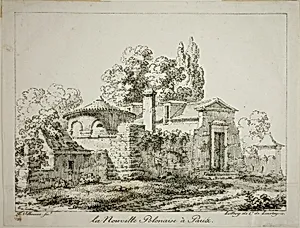
The New Polish in Paris
Medium
Lithograph in black on ivory laid paper, tipped onto ivory wove paper
Dimensions
Image: 13.5 × 18.5 cm (5 3/8 × 7 5/16 in.); Primary support: 15.5 × 20.2 cm (6 1/8 × 8 in.); Secondary support: 23 × 26.5 cm (9 1/16 × 10 7/16 in.)
Classification
lithograph
Department
Prints and Drawings
Museum
Art Institute of Chicago
Accession Number
41725
Rights
Public Domain
Art Historical Context
*The New Polish in Paris* is a charming 1819 lithograph by Louis Jules Frederic Vill, capturing a moment of cultural exchange in post-Napoleonic Paris. Created just two decades after the invention of lithography—a revolutionary printmaking technique that allowed artists to draw directly on limestone with greasy crayon, producing rich tonal effects—this work exemplifies the medium's early potential for detailed, affordable imagery. Printed in black ink on ivory laid paper and later tipped onto wove supports, its modest dimensions (image: 13.5 × 18.5 cm) made it ideal for collectors and urban viewers. The evocative title likely nods to the influx of Polish exiles in Paris following the Congress of Vienna (1815), which redrew Europe's map and sparked unrest in partitioned Poland. Villeneuve's scene reflects the city's vibrant cosmopolitanism, where émigrés introduced "new Polish" fashions or mannerisms amid the French capital's bustling social scene. Housed in the Art Institute of Chicago's Prints and Drawings department, this lithograph highlights lithography's role in disseminating satirical or observational prints, bridging fine art and popular culture during a transformative era. A delightful glimpse into 19th-century urban life!