
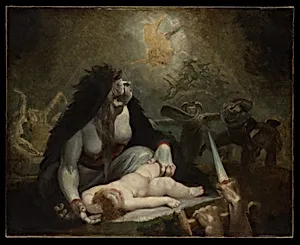
The Night-Hag Visiting Lapland Witches
1796
Medium
Oil on canvas
Dimensions
40 x 49 3/4 in. (101.6 x 126.4 cm)
Classification
Paintings
Department
European Paintings
Museum
Metropolitan Museum of Art, New York, NY
Credit
Purchase, Bequest of Lillian S. Timken, by exchange, and Victor Wilbour Memorial, The Alfred N. Punnett Endowment, Marquand and Charles B. Curtis Funds, 1980
Accession Number
1980.411
Rights
Public Domain
Tags
Art Historical Context
Step into the shadowy realm of Fuseli's *The Night-Hag Visitingland Witches* (1796), an oil on canvas that captures the artist's fascination with the supernatural and macabre. Measuring 40 x 49 3/4 inches, this dramatic painting depicts a night-hag—a, folklore-inspired demon—amid Lapland witches, incorporating haunting elements like nude female figures, vulnerable children, and ominous knives. Fuseli, a Swiss-born Romantic painter active in England, drew from Shakespearean visions and Nordic myths, blending eroticism with terror in his signature style of elongated forms and intense chiaroscuro lighting. Created during the late Enlightenment, when Romanticism was challenging rationalism with gothic fantasies, the work reflects Fuseli's role in the Royal Academy and his exploration of the irrational mind. The large-scale canvas amplifies its theatrical impact, inviting viewers to confront primal fears. Now in the Metropolitan Museum of Art's European Paintings collection—acquired through generous endowments in 1980—it exemplifies how Fuseli elevated nightmares into high art, influencing later horror genres in visual culture. This piece remains a chilling reminder of 18th-century obsessions with witchcraft and the occult, perfect for pondering the thin veil between dream and dread.
About the Artist
Henry Fuseli · 1741–1825
Henry Fuseli (1741-1825), born Johann Heinrich Füssli in Zürich, was a Swiss-British painter whose visionary works exploring dreams, nightmares, and psychological terror made him one of the most original figures of the Romantic movement. His art bridged Neoclassical discipline with Romantic emotionalism, creating images of supernatural intensity that would influence artists from William Blake to t...