
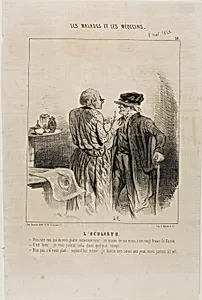
The Oculist (plate 18)
Medium
Lithograph in black on ivory wove paper
Dimensions
Image: 21.7 × 17.9 cm (8 9/16 × 7 1/16 in.); Sheet: 35.2 × 22.8 cm (13 7/8 × 9 in.)
Classification
lithograph
Department
Prints and Drawings
Museum
Art Institute of Chicago
Accession Number
51161
Rights
Public Domain
Art Historical Context
**The Oculist (plate 18)**, created by French artist Charles Émile Jac in 1843, a slice of 19th-century rural life the accessible medium of lithography. Jacque, a prominent member of the Barbizon School alongside artists like Millet and Corot, was renowned for his detailed depictions of peasants, farm animals, and everyday countryside scenes. This print, plate 18 from a series, likely portrays an oculist—an eye doctor—amid the humble trades of French provincial life, blending realism with a touch of wry observation. Printed in black ink on ivory wove paper, the lithograph measures a modest 21.7 × 17.9 cm for the image, allowing for intimate viewing. Lithography, perfected in the early 19th century, enabled artists like Jacque to achieve rich tonal gradations and fluid lines mimicking drawing, making high-quality art reproducible and affordable. Jacque's mastery of the technique shines in his textured rendering of figures and settings, reflecting the era's growing fascination with authentic rural narratives over idealized Romanticism. Housed in the Art Institute of Chicago's Prints and Drawings Department, *The Oculist* exemplifies Jacque's prolific output of over 1,400 prints, bridging fine art and popular imagery. It invites visitors to ponder the unsung professions that sustained village communities, offering a window into mid-19th-century France's social fabric.