
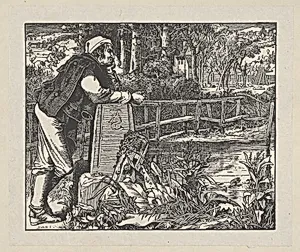
The Old Chartist
Medium
Wood engraving on chine collé; proof
Dimensions
Image: 4 1/8 in. × 5 in. (10.5 × 12.7 cm) Sheet: 4 7/8 × 5 11/16 in. (12.4 × 14.5 cm)
Classification
Prints
Department
Drawings and Prints
Museum
Metropolitan Museum of Art, New York, NY
Credit
Harris Brisbane Dick Fund, 1927
Accession Number
27.37.69(1)
Rights
Public Domain
Tags
Art Historical Context
In the hallowed halls of the Metropolitan Museum of, *The Old Chartist*1862) captures a poignant moment of reflection from Victorian Britain. Designed by Frederick Augustus Sandys a Pre-Raphael associate celebrated for his meticulous realism and emotional depth, and masterfully engraved by Joseph Swain, this wood engraving on chine coll—a delicate technique bonding thin Chinese paper to a support—serves as a rare proof impression. Measuring just 4 1/8 × 5 inches, its intimate scale draws viewers close to an elderly man gazing contemplatively near a bridge, evoking solitude and introspection amid Britain's industrial landscape. The title nods to the Chartist movement, a radical 19th-century campaign for political reform, including universal male suffrage and voting rights for workers. Created a decade after Chartism's decline, Sandys' work likely honors a weathered veteran, blending social commentary with artistic precision. Wood engraving, prized for its fine lines and tonal subtlety, allowed intricate details in clothing, weathered features, and atmospheric bridges—hallmarks of Pre-Raphaelite influence. As a proof from the Harris Brisbane Dick Fund (1927), it offers a glimpse into the printmaking process, underscoring the era's fusion of activism, artistry, and technical innovation. A timeless emblem of human resilience.