
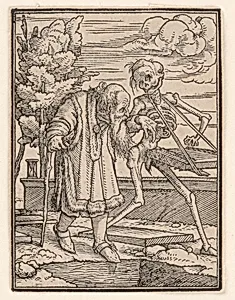
The Old Man, from The Dance of Death
ca. 1526, published 1538
Medium
Woodcut
Dimensions
sheet: 2 9/16 x 1 15/16 in. (6.5 x 4.9 cm)
Classification
Prints
Department
Drawings and Prints
Museum
Metropolitan Museum of Art, New York, NY
Credit
Rogers Fund, 1919
Accession Number
19.57.32
Rights
Public Domain
Art Historical Context
Welcome to the Metropolitan Museum of Art's collection of Renaissance prints. "The Old Man, from The Dance of Death is a masterful woodcut designed by Hans Holbein the around 1526 and expertly cut by Hans Lützel, then published posthumously in 1538. This tiny yet potent image (just 2 9/16 x 1 15/16 inches) belongs to Holbein's renowned series of 41 wood, which vividly illustrate the medieval allegory of *Danse Macabre*. In this tradition, Death dances indiscriminately with figures from every station of life, reminding viewers of mortality's universality amid the turbulent Reformation era. Holbein, a leading Northern Renaissance artist famed for his precise portraits and satirical edge, infused the series with dynamic compositions and expressive details. Lützelburger's woodcut technique—carving intricate designs into wooden blocks for inked impressions—allowed for remarkable fine lines and textures, making these affordable prints accessible to a wide audience beyond the elite. Here, Death confronts an elderly man, capturing the inevitability of life's end with stark realism and subtle humor. This work's cultural significance endures as a *memento mori*, urging reflection on human frailty during a time of plague, war, and religious upheaval. Acquired through the Rogers Fund in 1919, it exemplifies how printmaking democratized art, blending moral instruction with artistic brilliance.