
The Olive Orchard
1889
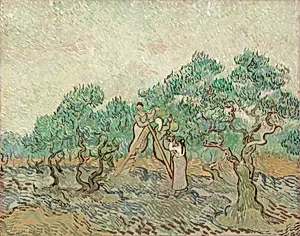
Medium
oil on canvas
Dimensions
overall: 73 × 92 cm (28 3/4 × 36 1/4 in.) framed: 97.5 x 114.9 x 10.1 cm (38 3/8 x 45 1/4 x 4 in.)
Classification
Painting
Department
CF
Museum
National Gallery of Art, Washington, D.C.
Credit
Chester Dale Collection
Accession Number
1963.10.152
Rights
Public Domain
Art Historical Context
Vincent van Gogh painted "The Olive Orchard" in 1889 during his stay at the asylum in Saint-Rémy-de-Provence. This period marked one of the artist's most productive phases, as he turned to the surrounding Provençal landscape for inspiration. As a key figure in Post-Impressionism, Van Gogh moved beyond Impressionist light effects to explore emotional and symbolic depths through nature. Executed in oil on canvas, the work measures 73 by 92 centimeters and showcases Van Gogh's signature techniques. Thick, swirling brushstrokes animate the olive trees and twisted branches, while vibrant greens and earth tones convey both the vitality of the grove and a sense of inner turbulence. The medium's rich texture allowed him to build expressive surfaces that pulse with energy. Part of a series of olive orchard paintings, this piece reflects Van Gogh's fascination with the region's ancient trees as symbols of endurance and renewal. Today it resides in the National Gallery of Art's Chester Dale Collection, where it continues to draw viewers into the artist's passionate dialogue with the natural world.
About the Artist
Vincent van Gogh · 1853–1890
Vincent Willem van Gogh (1853-1890) stands as one of the most influential figures in Western art history, despite a career spanning merely a decade. Born in Groot-Zundert, Netherlands, to a Protestant pastor's family, van Gogh's path to artistic greatness was anything but conventional. His early adulthood saw him working as an art dealer for Goupil & Cie, a language teacher, and a fervent missiona...