
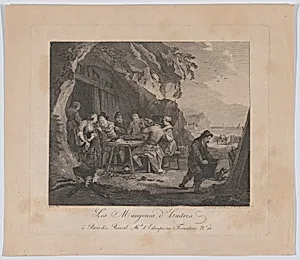
The Oyster Eaters
Medium
Engraving and etching
Dimensions
Sheet: 10 5/16 × 11 15/16 in. (26.2 × 30.3 cm) Plate: 8 11/16 × 9 7/8 in. (22 × 25.1 cm)
Classification
Prints
Department
Drawings and Prints
Museum
Metropolitan Museum of Art, New York, NY
Credit
Gift of Georgiana W. Sargent, in memory of John Osborne Sargent, 1924
Accession Number
24.63.1263
Rights
Public Domain
Tags
Art Historical Context
"The Oyster Eaters," created in 1778, captures a lively domestic scene of men and women gathered around a table to enjoy oysters, accompanied by elements of cooking, drinking, and even the presence of dogs. This engraving and etching, measuring just under nine by ten inches in the plate, reflects the everyday pleasures of 18th-century French social life. The collaborative effort among Jean-Baptiste Bénard, Jean Tessier, and the renowned engraver Jacques Philippe Le Bas highlights the period’s vibrant printmaking culture, where such works often reproduced paintings or drawings for wider audiences. Prints like this one played a significant role in disseminating images of contemporary manners and entertainments during the Enlightenment. Oysters, a popular and relatively accessible delicacy at the time, symbolized both conviviality and fleeting pleasures, themes that resonated in genre scenes meant for middle-class collectors. The combination of etching for fine details and engraving for tonal depth allowed Le Bas and his colleagues to convey texture—from glistening shells to animated expressions—with remarkable clarity. Housed in the Metropolitan Museum of Art’s Department of Drawings and Prints, this work offers modern viewers a charming glimpse into 18th-century leisure. Its gift in 1924 by Georgiana W. Sargent in memory of John Osborne Sargent underscores the enduring appeal of such intimate scenes across centuries.