
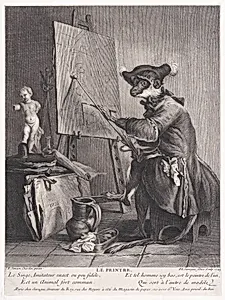
The Painter
Medium
Etching and engraving
Dimensions
Sheet (Trimmed): 12 1/16 × 9 1/16 in. (30.7 × 23 cm)
Classification
Prints
Department
Drawings and Prints
Museum
Metropolitan Museum of Art, New York, NY
Credit
Harris Brisbane Dick Fund, 1953
Accession Number
53.600.536
Rights
Public Domain
Tags
Art Historical Context
In the heart of 18th-century Rococo art, *The Painter* (1743) captures a whimsical yet insightful scene through the masterful collaboration of painter Jean Siméon Chardin engraver Louis Surugue. Chardin, renowned for his intimate still lifes and genre scenes that celebrated everyday life with remarkable realism and subtle light effects, provided the original composition. Surugue then translated it into an exquisite etching and engraving—a printmaking technique that allowed for intricate details and tonal depth through acid bites and burin work on copper plates. Measuring about 12 by 9 inches, this trimmed sheet exemplifies how such prints democratized art, making high-culture imagery accessible beyond elite patrons. The artwork playfully depicts monkeys dressed as artists at work, a popular motif in European satire symbolizing human folly, imitation, and the pretensions of the art world. Amid brushes, palettes, and canvases, these anthropomorphic primates poke fun at the creative process, blending humor with Chardin's observational precision. Created during the Enlightenment era, when such allegories critiqued societal vanities, it reflects the era's delight in clever visual puns. Housed in the Metropolitan Museum of Art's Drawings and Prints department (Harris Brisbane Dick Fund, 1953), *The Painter* showcases the technical brilliance of reproductive prints while inviting viewers to chuckle at art's absurdities—a timeless reminder of creativity's universal appeal.
About the Artist
Jean Siméon Chardin|Louis Surugue · 1699–1779
Jean-Baptiste-Siméon Chardin, born on November 2, 1699, in Paris to a cabinetmaker father who crafted billiard tables, grew up immersed in the city's artisan world on the Left Bank near Saint-Sulpice. His early training came through apprenticeships with the history painters Pierre-Jacques Cazes, where he honed academic drawing techniques, and Noël-Nicolas Coypel, whose assignment to copy a musket ...