
The Palaces
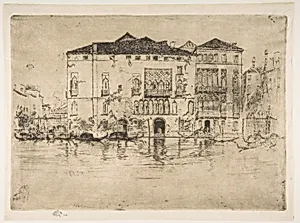
Medium
Etching, drypoint and open bite (?); fifth state of six (Glasgow); Printed in black ink on fine ivory laid paper
Dimensions
plate: 9 15/16 x 14 in. (25.2 x 35.6 cm) plate: 11 x 14 5/8 in. (27.9 x 37.1 cm)
Classification
Prints
Department
Drawings and Prints
Museum
Metropolitan Museum of Art, New York, NY
Credit
Gift of Felix M. Warburg and his family, 1941
Accession Number
41.1.196
Rights
Public Domain
Tags
Art Historical Context
James McNeill Whistler, leading figure in the Aesthetic movement and champion of "art for art sake," created *The Palaces* in 1879 during his transformative visit to Venice. Amid financial struggles, Whistler produced a renowned series of etchings known as the "Venice Set," capturing the city's waterways and grand architecture. This print depicts the iconic palaces along the Grand Canal, with boats gliding in the foreground, evoking's timeless allure through soft, atmospheric effects rather than precise details. Printed in black ink on fine ivory laid paper, *The Palaces* is an etching combined with drypoint and possible open bite—a sophisticated mixed technique. Etching uses acid to incise lines into a metal plate, while drypoint's direct needle scratches create velvety burrs for rich textures. The "open bite" allows acid to eat away broader areas, producing tonal passages that mimic Venice's misty light. This fifth state of six, as cataloged in the Glasgow Whistler inventory, showcases Whistler's refinements for subtle gradations. Housed in the Metropolitan Museum of Art as a gift from Felix M. Warburg and family, this work highlights Whistler's mastery of printmaking, influencing later artists with its emphasis on mood and harmony over narrative. Visitors will appreciate how it distills Venice's magic into intimate, poetic elegance.
About the Artist
James McNeill Whistler · 1834–1903
James Abbott McNeill Whistler (1834-1903) was an American-born painter and printmaker who became a leading figure in the Aesthetic Movement and pioneer of Tonalism and Japonisme. He revolutionized art by championing "art for art's sake" and treating paintings as visual equivalents of musical compositions, titling works as "arrangements," "harmonies," and "nocturnes" to emphasize formal qualities o...