
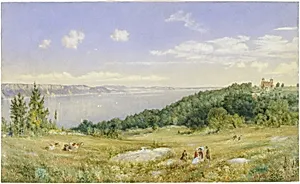
The Palisades
ca. 1870
Medium
Watercolor and gouache on white wove paper
Dimensions
1993.5289 5/8 x 16 1/8 in. (24.4 x 41 cm)
Classification
Watercolor
Culture
American
Department
The American Wing
Museum
Metropolitan Museum of Art, New York, NY
Credit
Morris K. Jesup Fund, 1993
Accession Number
1993.528
Rights
Public Domain
Tags
Art Historical Context
John William Hill's *The Palisades* (ca. 1870) captures the majestic cliffs rising along the Hudson River in New Jersey, a beloved subject in 19th-century American art Born in England and trained in his father's aquatint studio, Hill became a leading watercolorist in the United States, renowned for his precise depictions of nature. This landscape reflects the era's growing national pride in America's sublime wilderness, just after the Civil War, artists celebrated the country's natural heritage amid rapid industrialization. Executed in watercolor and gouache on white wove paper, the showcases Hill's mastery of these media. Watercolor's translucent layers create luminous skies and foliage, while gouache's opacity adds rich texture to rocky outcrops and river surfaces—techniques that allowed for intricate detail on a modest 15/8 x 16 1/8-inch sheet. Hill's meticulous style, influenced by scientific observation, evokes the Hudson River School's emphasis on light and atmosphere, bridging precise draftsmanship with poetic realism. Housed in The Metropolitan Museum of Art's American Wing through the Morris K. Jesup Fund (1993), *The Palisades* invites visitors to ponder the enduring allure of these iconic cliffs, visible from New York City and immortalized by generations of artists. A testament to American landscape tradition, it reminds us of nature's quiet power.
About the Artist
John William Hill · 1812–1879
American (born England), London 1812–1879 West Nyack, New York