
The Parade on the Boulevard
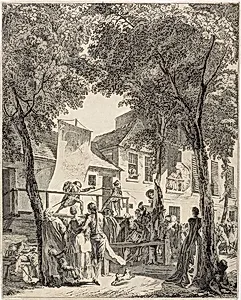
Medium
Etching, with additions in pen and black ink on cream laid paper
Dimensions
sheet (trimmed): 32.9 × 26.3 cm (13 × 10 3/8 in.)
Classification
etching
Department
Prints and Drawings
Museum
Art Institute of Chicago
Accession Number
129794
Rights
Public Domain
About this artwork
The bulk of Antoine-Jean Duclos's career was devoted to depicting small-scale, decorative subjects. This unfinished print was made after the work of Gabriel de Saint-Aubin, his master Augustin's older brother. The freer handling of this print, compared to those after Augustin, may reflect the very different approach to etching espoused by Gabriel. If the print can indeed be dated to 1760, it would represent a very early work by Duclos, who may have been apprenticed to Gabriel at the time.
Art Historical Context
Created in 1760 by French artist Antoine-Jean Duclos, *The Parade on the Boulevard* captures a lively public scene on a Parisian thoroughfare. The title suggests a moment of urban spectacle, possibly a military display or festive procession, reflecting the vibrant street life of mid-eighteenth-century France. As a work on paper now housed in the Art Institute of Chicago’s Prints and Drawings department, it offers viewers a window into the social rhythms of the period. The medium—an etching enhanced with pen and black ink on cream laid paper—highlights the artist’s skill in combining printed lines with hand-drawn details. Etching was a favored technique at the time for its ability to produce fine, expressive marks that could be widely reproduced, allowing such scenes to reach broader audiences beyond the elite. The sheet’s modest size (roughly 13 by 10 inches) further suggests it was designed for intimate viewing or inclusion in personal collections. This print exemplifies how eighteenth-century artists used the etching process to document contemporary events with both precision and artistic flair. Its presence in a major museum collection today invites modern visitors to appreciate the enduring appeal of these everyday moments preserved through delicate line work.