
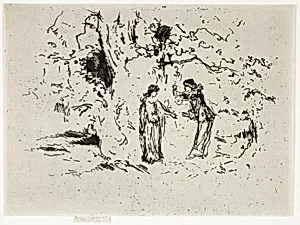
The Pastoral Play
1888
Medium
Etching in black on ivory laid paper
Dimensions
Image: 12.5 × 19 cm (4 15/16 × 7 1/2 in.); Plate: 15.9 × 21.8 cm (6 5/16 × 8 5/8 in.); Sheet: 16.5 × 21.6 cm (6 1/2 × 8 9/16 in.)
Classification
etching
Department
Prints and Drawings
Museum
Art Institute of Chicago
Accession Number
210909
Rights
Public Domain
Art Historical Context
*The Pastoral Play* (1888) by Theodore Roussel is a delicate etching in black ink on ivory laid paper, measuring a modest 12.5 × 19 cm for the image itself. Housed in the Art Institute of Chicago's Prints and Drawings department, this intimate work exemplifies the late 19th-century revival of etching as a fine art medium. Roussel, a French-born artist active in Britain, was renowned for his precise, atmospheric prints that often evoked poetic, everyday scenes—here suggested by the title's pastoral theme of rural idyll and leisurely play. Etching's technique is key to its charm: Roussel would have coated a copper plate with an acid-resistant ground, incising fine lines with a needle to expose the metal, then immersing it in acid to "bite" the grooves. Printed on high-quality laid paper, which reveals subtle chain lines under light, the result is rich tonal depth and velvety blacks, rivaling painting in expressiveness. This process allowed artists like Roussel to produce editions, making sophisticated art accessible beyond oil paintings. Created amid the Aesthetic movement's embrace of beauty for its own sake, *The Pastoral Play* reflects Victorian nostalgia for nature amid industrialization. Its small scale invites close viewing, rewarding visitors with Roussel's masterful control of line and space—a timeless invitation to linger in pastoral reverie.
About the Artist
Theodore Roussel · 1847–1926
Theodore Casimir Roussel was born on 23 March 1847 in Lorient, Brittany, France, into a naval family. After serving in the Franco-Prussian War, he began painting in 1872 as an entirely self-taught artist, initially rendering scenes of daily life in the meticulous style of the Old Masters. In 1878, he settled permanently in London, where he immersed himself in the vibrant British art scene. There, ...