
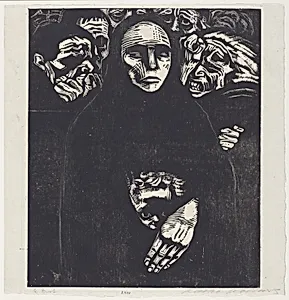
The People (Das Volk)
1922/1923
Medium
woodcut, touched with opaque white watercolor on Japan paper [trial proof]
Dimensions
image: 36 x 30 cm (14 3/16 x 11 13/16 in.) sheet: 37.5 x 36.3 cm (14 3/4 x 14 5/16 in.)
Classification
Department
CG-W
Museum
National Gallery of Art, Washington, D.C.
Credit
Rosenwald Collection
Accession Number
1943.3.5229
Rights
Public Domain
Art Historical Context
Käthe Kollwitz's *The People (Das Volk, created around 1922–1923, captures the raw struggles of the working class during the turbulent Weimar Republic era in Germany. Following World War I, the country grappled with hyperinflation, unemployment, and social upheaval, themes central to Kollwitz's Expressionist oeuvre. As a pioneering female artist and committed socialist, she drew from own experiences in working-class Berlin to portray the dignity and despair of ordinary folk, often elevating printmaking to a powerful tool for social commentary. This trial proof woodcut, enhanced with touches of opaque white watercolor on delicate Japan paper, exemplifies Kollwitz's mastery of the medium. Woodcuts, with their bold, carved lines and stark contrasts, allowed her to convey emotional intensity and monumental scale on an intimate 36 x 30 cm image. The hand-applied whites add luminous highlights, heightening the dramatic effect typical of her prints, which were affordable and thus accessible to the masses she championed. Housed in the National Gallery of Art's Rosenwald Collection, *The People* remains a poignant testament to Kollwitz's legacy as a voice for the voiceless, influencing generations of socially engaged artists. Visitors are invited to ponder its timeless call for empathy amid hardship.
About the Artist
Käthe Kollwitz · 1867–1945
Käthe Kollwitz (1867–1945) was a German artist whose powerful images of poverty, war, and maternal grief established her as the foremost practitioner of socially engaged art in early 20th-century Europe. Working primarily in printmaking—including etching, lithography, and woodcut—as well as drawing and sculpture, Kollwitz created works of raw emotional power that gave voice to the suffering of wor...