
The Perambulator
1916
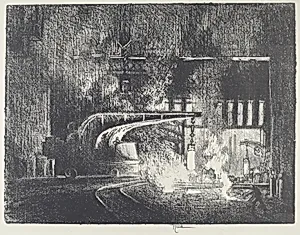
Medium
lithograph
Classification
Department
CG-W
Museum
National Gallery of Art, Washington, D.C.
Credit
Rosenwald Collection
Accession Number
1943.3.7277
Rights
Public Domain
Art Historical Context
**The Perambulator**, a 1916 lithograph American artist Joseph Pennell, captures the artist's keen eye for everyday urban life during a tumultuous era. Pennell (1857–1926), a master printmaker influenced by James McNeill Whistler, was renowned for his dynamic depictions of cities, architecture, and industrial across Europe and America. Created amid World War I, this print from the National Gallery of Art's Rosenwald Collection reflects the bustling street scenes Pennell favored, with the title evoking a baby carriage—or perambulator—amid the rhythm of modern life. Lithography, Pennell's preferred medium, allowed for rich tonal gradations and atmospheric depth through its planographic process, where images are drawn on stone or metal plates with greasy crayons and inks. This technique revolutionized printmaking in the late 19th and early 20th centuries, enabling artists like Pennell to produce affordable yet expressive original works that rivaled paintings in detail and mood. As a fine art print classified in the NGA's CG-W department, it exemplifies the era's print revival. Pennell's precise yet evocative style invites viewers to ponder the ordinary amid historical upheaval, making *The Perambulator* a charming window into early 20th-century observation. Part of the esteemed Rosenwald Collection, it highlights the enduring appeal of prints in preserving fleeting moments.
About the Artist
Joseph Pennell · 1857–1926
Joseph Pennell (1857–1926) was born in Philadelphia to Quaker parents and displayed an early aptitude for drawing, finding solace in sketching amid a challenging childhood. He received initial drawing instruction from James R. Lambdin and his first etching lessons from Stephen Ferris in 1879. Pennell attended night classes at the Pennsylvania Museum and School of Industrial Art before studying at ...