
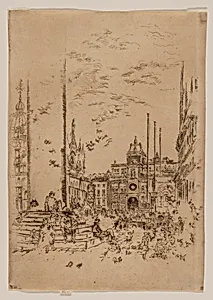
The Piazzetta
1879/80
Medium
Etching and drypoint with foul biting in brown ink on ivory laid paper
Dimensions
Image, trimmed within platemark: 25.4 × 18 cm (10 × 7 1/8 in.); Sheet: 25.7 × 18 cm (10 1/8 × 7 1/8 in.)
Classification
etching
Department
Prints and Drawings
Museum
Art Institute of Chicago
Accession Number
109181
Rights
Public Domain
Art Historical Context
James McNeill Whistler’s *The Piazzetta* (1879/80) captures the atmospheric essence of Venice’s iconic Piazzetta di San Marco during the artist’s transformative visit to the city. Exiled from London after a high-profile libel trial, Whistler arrived in Venice with few resources, producing around 50 groundbreaking etchings that revitalized his career. This intimate print, housed in the Art Institute of Chicago’s Prints and Drawings collection, exemplifies his shift toward subtle tonal harmonies, prioritizing mood and suggestion over literal detail—a hallmark of the Aesthetic movement’s “art for art’s sake” philosophy. Rendered in etching and drypoint with foul biting on ivory laid paper, the work showcases Whistler’s masterful printmaking techniques. Etching provides crisp, controlled lines, while drypoint’s burr creates velvety textures for depth and softness. Foul biting—unintentional corrosion from acid—adds gritty, organic incidents that enhance the luminous, misty quality of Venetian light reflecting off architecture and water. Trimmed close to the platemark at 25.4 × 18 cm, it invites close viewing to appreciate these nuances. Whistler’s Venice series, including this gem, influenced modern printmaking by embracing imperfection and evoking fleeting impressions, bridging Realism and Impressionism. A must-see for admirers of 19th-century innovation!
About the Artist
James McNeill Whistler · 1834–1903
James Abbott McNeill Whistler (1834-1903) was an American-born painter and printmaker who became a leading figure in the Aesthetic Movement and pioneer of Tonalism and Japonisme. He revolutionized art by championing "art for art's sake" and treating paintings as visual equivalents of musical compositions, titling works as "arrangements," "harmonies," and "nocturnes" to emphasize formal qualities o...