
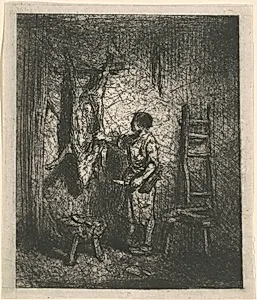
The Pig Butcher
Medium
etching with engraving on chinese paper
Dimensions
sheet: 10.5 × 19 cm (4 1/8 × 7 1/2 in.) image: 9.7 × 8.1 cm (3 13/16 × 3 3/16 in.)
Classification
Department
CG-E
Museum
National Gallery of Art, Washington, D.C.
Credit
Purchased as the Gift of Andrew Robison
Accession Number
2016.106.2
Rights
Public Domain
Art Historical Context
**The Pig Butcher** (1844) by Charles Émileque captures the gritty realities of rural French life through a masterful etching combined with engraving on delicate Chinese paper. Jacque, a prominent figure in the Barbizon School artists like Millet and Rousseau, specialized in pastoral scenes featuring animals and peasants. This intimate print, measuring just 9.7 × 8.1 cm, reflects the mid-19th-century Realist movement's embrace of everyday labor, moving away from idealized Romanticism toward unvarnished depictions of the countryside. The etching technique—where acid etches intricate lines into a metal plate, finished with precise engraving—allowed Jacque to achieve remarkable texture and depth, evoking the sheen of fur and the tension of the moment. Printed on thin, absorbent Chinese paper, it produces rich, velvety blacks and subtle tones, enhancing the work's atmospheric drama. Such papers were prized by 19th-century printmakers for their ability to hold fine ink details without distortion. Today, housed in the National Gallery of Art (purchased as the gift of Andrew Robison), **The Pig Butcher** offers a window into pre-industrial village life, reminding visitors of the vital, often visceral roles like butchery that sustained communities. Jacque's keen observation celebrates the humble worker, making this small-scale gem a poignant highlight of printmaking's golden age.