
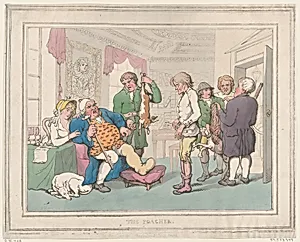
The Poacher
May 1, 1806
Medium
Hand-colored etching
Dimensions
Sheet: 12 5/8 × 15 3/4 in. (32 × 40 cm)
Classification
Prints
Department
Drawings and Prints
Museum
Metropolitan Museum of Art, New York, NY
Credit
The Elisha Whittelsey Collection, The Elisha Whittelsey Fund, 1959
Accession Number
59.533.949
Rights
Public Domain
Tags
Art Historical Context
Thomas Rowlandson's *The Poacher* (May 1, 1806) is a vibrant hand-colored etching that captures the artist's signature satirical flair. A leading British caricaturist of the late 18th and early th centuries, Rowlandson delighted audiences with his witty, exaggerated depictions of everyday follies and social vices. This print, measuring 12 5/8 × 15 3/4 inches, exemplifies his mastery of etching—a technique where acid bites into a metal plate to create intricate lines—enhanced by hand-applied watercolors for lively, theatrical effects that made his works affordable and popular among the middle class. The scene humorously portrays men, women, and dogs in hot pursuit of rabbits, poking fun at the illicit thrill of poaching. In Regency-era England, strict game laws reserved hunting for the aristocracy, making poaching a rebellious act by the lower classes—and ripe material for satire. Rowlandson's loose, fluid style animates the chaos, blending slapstick comedy with sharp social commentary on class tensions and rural mischief. Housed in the Metropolitan Museum of Art's Drawings and Prints department, this piece from The Elisha Whittelsey Collection highlights Rowlandson's enduring influence on caricature art, bridging fine art and popular culture. Visitors will appreciate its cheeky energy, a window into Britain's spirited printmaking tradition.
About the Artist
Thomas Rowlandson · 1756–1827
Thomas Rowlandson (1757–1827) was an English artist and caricaturist whose satirical watercolors and prints captured the social life of Georgian Britain with unparalleled wit and technical mastery. Alongside James Gillray, he is recognized as one of the greatest British graphic artists, and his distinctive flowing line and keen observations have made his work integral to understanding late 18th an...