
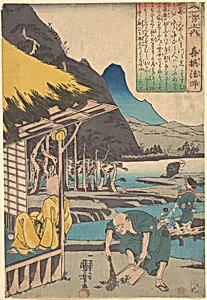
The Poet's Cabin in Tatsumi
Medium
Woodblock print; ink and color on paper
Dimensions
H. 13 1/8 in. (33.3 cm); W. 8 15/16 in. (22.7 cm)
Classification
Prints
Culture & Period
Japan · Edo period (1615–1868)
Department
Asian Art
Museum
Metropolitan Museum of Art, New York, NY
Credit
Rogers Fund, 1919
Accession Number
JP1120
Rights
Public Domain
Tags
Art Historical Context
Utagawa Kuniyoshi1797–1861), a leading figure in Japan's ukiyo-e tradition during the Edo period (1615–1868), created *The Poet's Cabin in Tatsumi* in 1845. This woodblock print a serene yet industrious scene in the Tatsumi district of Edo (modern-day Tokyo), evoking the "floating world" of everyday life amid natural beauty. Kuniyoshi renowned for his dynamic warrior prints and whimsical imagery, here blends human activity with mountainous landscapes, highlighting the harmony between people and their environment. Printed in vibrant inks and colors on paper—a technique known as *nishiki-e* or "brocade pictures"—the work showcases the precision of collaborative woodblock printing, where carvers, printers, and publishers brought Kuniyoshi's bold lines and subtle gradations to life. At 13 1/8 x 8 15/16 inches, its intimate scale invites close viewing of men and women engaged in working tasks within a modest cabin, perhaps alluding to poetic retreat and rural simplicity. This piece reflects Edo Japan's cultural fascination with literati ideals and labor, bridging urban sophistication with nature's tranquility. Acquired through the Rogers Fund in 1919, it exemplifies how ukiyo-e prints democratized art, influencing global aesthetics long after the period's close.
About the Artist
Utagawa Kuniyoshi · 1797–1861
Utagawa Kuniyoshi (1797–1861) was born in Edo to the silk-dyer Yanagiya Kichiyemon, originally bearing the childhood name Yoshisaburō. From a young age, he assisted in his family's pattern design work, which sharpened his innate mastery of color and textile motifs that would permeate his later prints. At around twelve years old, his prodigious drawing skills drew the attention of the renowned Utag...