
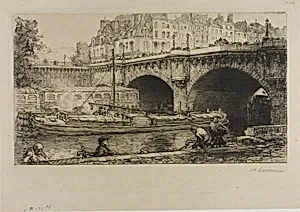
The Pont-Neuf
Medium
Etching on cream wove paper
Dimensions
Image: 17.2 × 31 cm (6 13/16 × 12 1/4 in.); Plate: 20.9 × 32 cm (8 1/4 × 12 5/8 in.); Sheet: 24 × 34.1 cm (9 1/2 × 13 7/16 in.)
Classification
etching
Department
Prints and Drawings
Museum
Art Institute of Chicago
Accession Number
46322
Rights
Public Domain
Art Historical Context
Louis Auguste Lepère's *The Pont-Neuf* (1901) captures the timeless allure of Paris's oldest standing bridge, the iconic Pont-Neuf spanning the Seine River. As a master French printmaker and illustrator active in the late 19th and early 20th centuries,ère was renowned for his evocative etchings of urban life, blending Realism with a poetic sensitivity to light and atmosphere. This work, housed in the Art of Chicago's Prints and department, reflects the Belle Époque era's fascination with the city's evolving landscape, where historic structures like the Pont-Neuf stood as symbols of continuity amid modernization. Rendered as an etching on cream wove paper, the piece measures a modest image size of 17.2 × 31 cm, allowing for intimate detail in its panoramic view. Etching, Lepère's preferred medium, involves incising lines into a metal plate with acid, creating rich tonal variations and subtle textures that mimic drawing. This technique was central to the revival of original printmaking in fin-de-siècle France, enabling artists to produce affordable yet collectible works that rivaled paintings in expressiveness. Visitors will appreciate how Lepère's composition draws the eye across the bridge's sturdy arches and bustling riverbanks, evoking the daily rhythm of Parisian life. A testament to the enduring charm of the City of Light, this etching invites contemplation of history's quiet grandeur.
About the Artist
Louis Auguste Lepère · 1849–1918
Louis-Auguste Lepère (1849–1918) was born in Paris on November 30 to the sculptor François Lepère, immersing him early in the artistic world. At age thirteen, he apprenticed in the studio of the English wood engraver Joseph Burn-Smeeton, training there from 1862 to 1867, and later attended drawing courses under Horace Lecoq de Boisbaudran at the Petite École (now École nationale supérieure des art...