
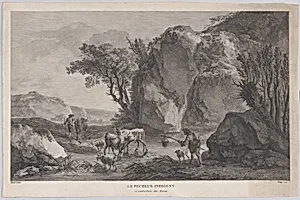
The Poor Fisherman
Medium
Etching and engraving
Dimensions
Image: 10 1/8 × 16 9/16 in. (25.7 × 42.1 cm) Sheet: 11 9/16 × 17 9/16 in. (29.4 × 44.6 cm)
Classification
Prints
Department
Drawings and Prints
Museum
Metropolitan Museum of Art, New York, NY
Credit
Rogers Fund, 1962
Accession Number
62.602.968
Rights
Public Domain
Tags
Art Historical Context
*The Poor Fisherman* is a captivating 18th-century print created through collaborative efforts by French artists Pierre François Basan, Pierre Louis Laurent Hoü, and Jeanne Deny 1770 and 179. Produced as an etching and engraving meticulous printmaking technique that allowed for detailed reproductions and widespread dissemination of images—this work measures about 10 by 16 inches and exemplifies the era's fascination with pastoral scenes. Housed in the Metropolitan Museum of Art's Drawings and Prints department, it was acquired through the Rogers Fund in 1962. The composition evokes a humble rural landscape, featuring a fisherman amid everyday struggles, accompanied by men, goats, and cows. This portrayal reflects late Enlightenment interests in the lives of the working poor, blending realism with romanticized nature. Hoüel, known for his topographic views from travels in Italy and Sicily, likely contributed the original design, while Basan, a prominent engraver and publisher, refined the intricate lines to capture textures of land, animals, and human toil. Etching and engraving's precision made such prints affordable art for collectors, bridging fine art and popular culture. *The Poor Fisherman* invites visitors to ponder the dignity in simplicity, a timeless theme amid France's social upheavals on the eve of Revolution.