
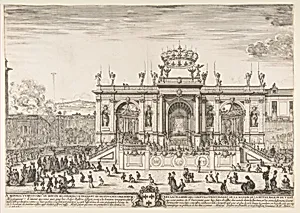
The Procession of the Holy Sacrament
Medium
Etching, state iii
Dimensions
sheet: 13 1/8 x 18 11/16 in. (33.4 x 47.5 cm)
Classification
Prints
Department
Drawings and Prints
Museum
Metropolitan Museum of Art, New York, NY
Credit
The Elisha Whittelsey Collection, The Elisha Whittelsey Fund, 1959
Accession Number
59.570.383
Rights
Public Domain
Tags
Art Historical Context
In the grand tradition of Baroque printmaking, Stefano della Bella *The Procession of the Holy Sacrament (ca. 1648) captures the fervor of a Catholic religious parade through a bustling urban scene. This etching, in its third state, showcases della Bella's mastery of intricate line work, depicting a throng of devotees carrying the Holy Sacrament amid temporary altars and ornate canopies. Created during the artist's time in Paris after his Florentine training under the Medici, the print reflects the opulent processions common in 17th-century Europe, evoking communal piety and spectacle. Della Bella, a leading etcher of his era, employed fine, cross-hatched lines to convey depth, movement, and texture on a large sheet (13 1/8 x 18 11/16 in.), making it ideal for wide distribution. Dedicated or associated with Tubeuf, Baron de Vert—a prominent French patron—the work highlights the intersection of Italian technique and French courtly culture. Housed in the Metropolitan Museum of Art's Elisha Whittelsey Collection, it exemplifies how prints democratized art, allowing viewers beyond the elite to experience sacred rituals. This piece invites us to ponder the cultural role of public devotion in Counter-Reformation Europe, where such processions reinforced faith amid social gatherings. A testament to della Bella's dynamic compositions, it remains a vivid window into 17th-century life.
About the Artist
Stefano della Bella|Tubeuf Baron de Vert · 1610–1664
Stefano della Bella (1610-1664) was one of the most prolific and versatile printmakers of the Italian Baroque period, leaving behind 1,052 prints and several thousand drawings that captured the vivid essence of 17th-century European life. Born in Florence on May 18, 1610, to a family of artists, he trained initially as a goldsmith before studying painting under Cesare Dandini and etching under Rem...