
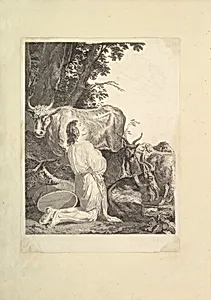
The Prodigal Son
Medium
Etching; early state
Dimensions
Sheet (trimmed close to plateline): 20 1/4 × 15 1/16 in. (51.5 × 38.2 cm) Leaf: 28 15/16 × 20 1/2 in. (73.5 × 52 cm)
Classification
Prints
Department
Drawings and Prints
Museum
Metropolitan Museum of Art, New York, NY
Credit
Harris Brisbane Dick Fund, 1925
Accession Number
25.62.51v
Rights
Public Domain
Tags
Art Historical Context
Behold *The Prodigal Son (1781), a etching in its early state, capturing the biblical parable from Luke 15 where a wayward son returns humbly to his forgiving father amid a rustic landscape teeming with men, cows, and goats. print reproduces a composition by the Baroque master Salvator Rosa (1615–1673), renowned for his dramatic, rugged scenes blending history painting with wild Italianate scenery. Rosa's turbulent style infuses the narrative with emotional intensity, evoking themes of redemption and human frailty that resonated deeply in 17th-century Europe. Crafted by engraver Simon Francis Ravenet the elder, with involvement from publisher John Boydell and printmaker Richard Earlom, this work exemplifies the late 18th-century boom in reproductive prints. Etching—a precise intaglio technique using acid to bite lines into a copper plate—allowed for rich tonal depth, especially prized in early proofs like this one, before later states added refinements. At nearly 20 by 15 inches (sheet), it's a generous format that highlights Rosa's sweeping vista, making grand art accessible to collectors beyond oil paintings. Acquired through the Harris Brisbane Dick Fund and housed in The Metropolitan Museum of Art's Drawings and Prints department, this piece underscores prints' role in democratizing culture during the Enlightenment, bridging Baroque drama with Georgian-era innovation for timeless reflection.