
The Prodigal Son
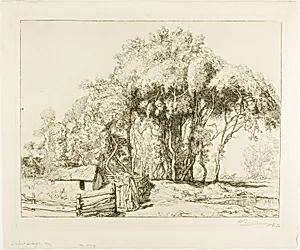
Medium
Etching on cream laid paper
Dimensions
Image: 24.3 × 32.2 cm (9 5/8 × 12 11/16 in.); Plate: 26.3 × 33.2 cm (10 3/8 × 13 1/8 in.); Sheet: 30.7 × 36.9 cm (12 1/8 × 14 9/16 in.)
Classification
etching
Department
Prints and Drawings
Museum
Art Institute of Chicago
Accession Number
35988
Rights
Public Domain
Art Historical Context
**The Prodigal Son (1913) is a poignant etching by French artist Louis Auguste Lepère (184–1918), capturing the biblical parable from Luke 15. In this scene, the wayward son returns home, by his forgiving father—a timeless tale of redemption and familial love. Created on the eve of World War I, Lepère's work reflects the era's interest in moral narratives through fine art prints, blending spiritual depth with his signature realism. Etching, Lepère's favored medium, involves coating a metal plate with acid-resistant ground, scratching lines into it, and immersing it in acid to etch the grooves. Printed on cream laid paper, this 24.3 × 32.2 cm image showcases the technique's precision, allowing rich tonal contrasts and intricate details that evoke emotion and texture. As a master printmaker influenced by 19th-century French traditions, Lepère elevated etching from reproductive tool to expressive art form. Housed in the Art Institute of Chicago's Prints and Drawings department, this piece highlights the accessibility of etchings, which democratized high art for collectors. Its modest scale invites close viewing, revealing Lepère's masterful linework and subtle storytelling—a gem for visitors pondering humanity's enduring themes.
About the Artist
Louis Auguste Lepère · 1849–1918
Louis-Auguste Lepère (1849–1918) was born in Paris on November 30 to the sculptor François Lepère, immersing him early in the artistic world. At age thirteen, he apprenticed in the studio of the English wood engraver Joseph Burn-Smeeton, training there from 1862 to 1867, and later attended drawing courses under Horace Lecoq de Boisbaudran at the Petite École (now École nationale supérieure des art...