
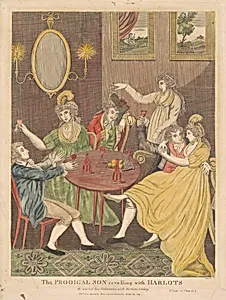
The Prodigal Son Revelling with Harlotsy
1814
Medium
hand-colored engraving on wove paper
Dimensions
image: 31.75 × 24.45 cm (12 1/2 × 9 5/8 in.) sheet: 36.67 × 27.94 cm (14 7/16 × 11 in.)
Classification
Department
CG-W
Museum
National Gallery of Art, Washington, D.C.
Credit
Corcoran Collection (Museum Purchase, Mary E. Maxwell Fund)
Accession Number
2015.19.592
Rights
Public Domain
Art Historical Context
**The Prodigal Son Revelling withlots** (1814) by Amos Doolittle captures vivid moment from the Biblical parable in Luke 15, where the wayward son squanders his inheritance in riotous living amid harlots and revelers. American engraver Amos Dool, active in Connecticut during the late 18th early 19th centuries, specialized in moralistic and historical prints that resonated with audiences seeking affordable, illustrative art. This hand-colored engraving on wove paper—measuring about 12½ × 9⅝ inches—exemplifies his skill in translating moral lessons into accessible imagery for homes and churches. Doolittle's technique shines through intricate line work typical of copperplate engraving, enhanced by meticulous hand-coloring that brings the debauched scene to life with vibrant hues on smooth wove paper. In 1814, amid America's post-Revolutionary fervor and Second Great Awakening, such prints served as visual sermons, warning against vice and excess while promoting repentance. The detailed composition likely draws viewers into the son's folly, heightening the parable's dramatic contrast with his later redemption. Part of the National Gallery of Art's Corcoran Collection, this work highlights early American printmaking's role in cultural education, blending artistry with piety for everyday edification.