
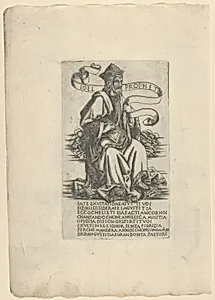
The Prophet Joel, from Prophets and Sibyls
1480–90
Medium
Engraving
Dimensions
Sheet: 11 7/16 × 7 15/16 in. (29.1 × 20.2 cm) Plate: 7 × 4 1/4 in. (17.8 × 10.8 cm)
Classification
Prints
Department
Drawings and Prints
Museum
Metropolitan Museum of Art, New York, NY
Credit
Harris Brisbane Dick Fund, 1929
Accession Number
29.16.21
Rights
Public Domain
Tags
Art Historical Context
In the late 15th century,entine engraver Francesco Rosselli created *The Prophet Joel, from and Sibyls* (ca. 1480–90), a striking engraving that captures the Renaissance fascination with biblical prophets alongside classical sibyls—pagan seers revered in Christian art as foretellers of Christ. Joel, known from the Old Testament for his vivid prophecies of judgment and restoration, is depicted with solemn intensity, embodying the era's blend of sacred scripture and humanist revival of antiquity. Rosselli, active in Florence during a golden age of artistic innovation, contributed to a series that reflected the intellectual and spiritual currents of the time, much like the prophetic figures later immortalized by Michelangelo in the Sistine Chapel. This work exemplifies the technical mastery of engraving, a revolutionary printmaking medium where intricate lines are incised into a copper plate, inked, and pressed onto paper. Measuring just 7 × 4¼ inches on the plate, Rosselli's precise burin work allowed for fine details in drapery, expressive gestures, and symbolic attributes, making complex religious imagery accessible beyond elite patrons. Housed in the Metropolitan Museum of Art's Drawings and Prints department (Harris Brisbane Dick Fund, 1929), it highlights engraving's role in democratizing art during the Renaissance, bridging workshops and collectors across Europe.