
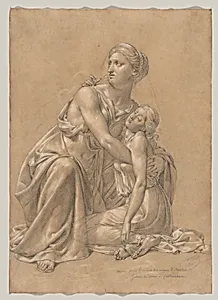
The Punishment of Niobe
ca. 1822–28
Medium
conté crayon and white chalk
Dimensions
14 1/2 × 10 3/8 in. (36.8 × 26.4 cm)
Classification
Drawings
Department
Drawings and Prints
Museum
Metropolitan Museum of Art, New York, NY
Credit
Gift of Roberta J.M. Olson and Alexander B.V. Johnson, 2020
Accession Number
2020.278
Rights
Public Domain
Tags
Art Historical Context
In the early 19th century, artist Merry-Joseph Blond captured a dramatic moment from Greek mythology in *The Punishment of Niobe* (ca. 1822–28). This intimate drawing, measuring just 14½ × 10⅜ inches, depicts the tragic queen Niobe, whose hubris in boasting of her many children provoked the gods Apollo and Artemis to slay her offspring. Transformed into a weeping stone on Mount Sipylus, Niobe became a symbol of eternal grief, a tale immortalized by Ovid in the *Metamorphoses*. Blondel, a Neoclassical painter trained under Jacques-Louis David, employed conté crayon—a versatile medium of compressed graphite or charcoal invented during the French Revolution—and white chalk on a tinted ground to achieve rich tonal contrasts and luminous highlights. This technique allowed for subtle modeling of forms, evoking the sculptural quality of ancient marble statues while conveying profound emotion, bridging Neoclassicism's reverence for antiquity with emerging Romantic sensibilities. Now at the Metropolitan Museum of Art through a 2020 gift, this preparatory drawing highlights women's pivotal roles in mythological narratives and Blondel's skill in translating grand themes into delicate works on paper, offering visitors a poignant glimpse into 19th-century artistic interpretation of classical tragedy.