
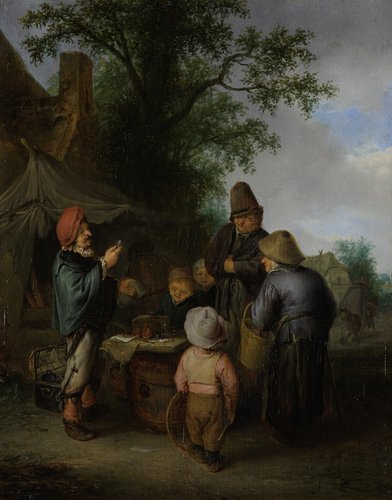
The Quacksalver
Medium
oil on panel
Dimensions
23.7; 29
Rights
Public Domain
About this artwork
olieverf op paneel
Art Historical Context
Adriaen van Ostade’s *The Quacksalver* (1648) captures the lively spirit of Dutch Golden Age genre painting. Working in Haarlem during the prosperous seventeenth century, van Ostade specialized in intimate scenes of everyday peasant life, often infusing them with gentle humor and moral undertones. This small oil-on-panel work, measuring just 29 by 23.7 centimeters, invites close viewing, typical of the detailed cabinet pictures popular among Dutch burghers. The title refers to a traveling charlatan peddling dubious cures, a common subject that allowed artists to comment on human gullibility and social pretense. Van Ostade’s warm palette and meticulous brushwork bring the crowded scene to life, highlighting the textures of clothing, faces, and makeshift stage. Oil on panel was prized in the Netherlands for its smooth surface and ability to render fine detail, helping the artist achieve the luminous quality that distinguishes his work. Housed in the Rijksmuseum, the painting offers modern viewers a vivid window into seventeenth-century Dutch society and its fascination with both entertainment and moral instruction.
About the Artist
Adriaen van Ostade · 1610–1685
Adriaen Jansz. van Ostade (1610-1685) was a Dutch Baroque painter and printmaker who specialized in genre scenes of peasant life. Born and raised in Haarlem, he became one of the most prolific and celebrated artists of the Dutch Golden Age, producing over 800 paintings, 50 etchings, and numerous drawings. Van Ostade's significance in art history lies in his masterful depiction of peasant life, a ...