
The Raising of Lazarus
1615–73
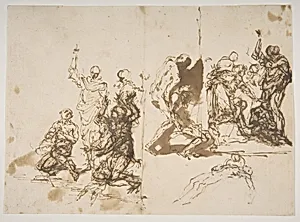
Medium
Pen and brown ink, brush and brown wash, over a little black chalk
Dimensions
7 15/16 x 10 13/16in. (20.1 x 27.5cm)
Classification
Drawings
Department
Drawings and Prints
Museum
Metropolitan Museum of Art, New York, NY
Credit
Harris Brisbane Dick Fund, 1938
Accession Number
38.179.2
Rights
Public Domain
Tags
Art Historical Context
Step into the dramatic world of 17th-century Italy with *The Raising of Lazarus*, a masterful drawing by Salvator Rosa1615–1673). Rosa, a versatile Baroque artist from Naples, was renowned for his turbulent landscapes, battle scenes, and paintings infused with Caravaggesque drama and emotional intensity. This work depicts the biblical miracle from the Gospel of John, where Jesus resurrects Lazarus, surrounded by astonished figures—a quintessential theme of faith, resurrection, and human wonder resonated deeply in Counter-Reformation Europe. Crafted in pen and brown ink with brush and brown wash over subtle black chalk, the drawing (7 15/16 x 10 13/16 in.) showcases Rosa's virtuoso technique. The fluid ink lines define dynamic poses and expressive faces, while the brown wash builds shadowy depth, evoking the chiaroscuro effects of his oil paintings. Such preparatory-style sheets were prized in the Baroque era for capturing spontaneous energy, often serving as studies for larger compositions. Acquired through the Harris Brisbane Dick Fund in 1938, this gem from the Metropolitan Museum of Art's Drawings and Prints department highlights Rosa's skill in rendering human figures with raw emotion. It invites visitors to appreciate the intimacy of drawings, where every stroke pulses with life and divine power.
About the Artist
Salvator Rosa · 1615–1673
Salvator Rosa was born in 1615 in Arenella, on the outskirts of Naples, into a world of artistic ambition and turbulent talent. His early training came through his maternal uncle, the painter Paolo Greco, and his brother-in-law Francesco Fracanzano, himself a pupil of the great Spanish-born Neapolitan master Jusepe de Ribera. Rosa showed a fierce independence from the start, resisting his father's...