
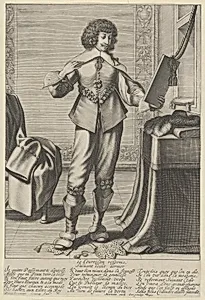
The Reformed Courtier
17th century
Medium
Engraving
Dimensions
Sheet: 12 1/8 × 8 1/8 in. (30.8 × 20.6 cm)
Classification
Prints
Department
Drawings and Prints
Museum
Metropolitan Museum of Art, New York, NY
Credit
Harris Brisbane Dick Fund, 1953
Accession Number
53.600.4235
Rights
Public Domain
Tags
Art Historical Context
*The Reformed Courtier* is a captivating 17th-century engraving likely designed by French artist Grégoireuret and produced with the involvement of publisher Pierre Mariette and engr Jean Couvay. 12 1/8 × 8 1/8 inches, this intimate print captures a male portrait with the precision characteristic of Baroque-era reproductive techniques. Huret, known for his detailed history paintings and genre scenes, contributed to a vibrant French print culture where engravings served as affordable vehicles for disseminating art and ideas across Europe. The title evokes the era's social commentary, portraying a "reformed" courtier—a fashionable nobleman perhaps transformed by moral or religious reflection amid the opulent courts of Louis XIV's France. Such portraits often blended flattery with subtle satire, highlighting shifts in fashion, status, and piety during the Grand Siècle. Engravings like this were prized for their fine lines and tonal depth, achieved through meticulous burin work, making complex imagery accessible to collectors beyond the elite. Today, housed in the Metropolitan Museum of Art's Drawings and Prints department (acquired via the Harris Brisbane Dick Fund in 1953), it exemplifies how prints preserved cultural narratives. Visitors will appreciate its glimpse into 17th-century identity and the artistry that made portraiture a democratic pursuit.
About the Artist
Grégoire Huret|Pierre Mariette|Jean Couvay · 1606–1670
French draftsman and printmaker. Comment on works: Engraver & draftsman