
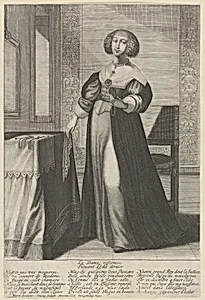
The Reformed Woman
17th century
Medium
Engraving
Dimensions
Sheet: 12 3/16 × 8 3/16 in. (31 × 20.8 cm)
Classification
Prints
Department
Drawings and Prints
Museum
Metropolitan Museum of Art, New York, NY
Credit
Harris Brisbane Dick Fund, 1953
Accession Number
53.600.4236
Rights
Public Domain
Tags
Art Historical Context
In this seventeenth-century engraving, a poised woman stands at the center of a domestic interior, her right hand resting on a cloth-draped table while her left holds a small object. She wears a long, dark gown with voluminous sleeves over a lighter underskirt, a wide white collar, and a cross pendant at her neck. Her curled hair frames a serene face, and the room behind her features paneled walls, a shuttered window, and the suggestion of a canopied bed, all rendered through precise, hatched lines that create subtle tonal depth on the paper. The work is titled The Reformed Woman and is attributed to Grégoire Huret, with contributions from Pierre Mariette and Jean Couvay. Produced as an engraving, it exemplifies the refined printmaking techniques popular in France during this period, when such images often circulated as moral or fashionable commentaries. Now in the collection of the Metropolitan Museum of Art, the print invites viewers to consider how clothing and demeanor could signal personal or social transformation in the seventeenth century.
About the Artist
Grégoire Huret|Pierre Mariette|Jean Couvay · 1606–1670
French draftsman and printmaker. Comment on works: Engraver & draftsman