
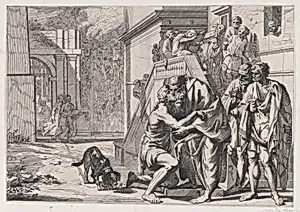
The return of the Prodigal Son
1650–1700
Medium
Etching
Dimensions
sheet: 7 15/16 x 11 5/8 in. (20.1 x 29.5 cm)
Classification
Prints
Department
Drawings and Prints
Museum
Metropolitan Museum of Art, New York, NY
Credit
The Elisha Whittelsey Collection, The Elisha Whittelsey Fund, 1951
Accession Number
51.501.4230
Rights
Public Domain
Art Historical Context
This etching, created between 1650 and 1700, captures the poignant biblical moment of the Prodigal Son’s return, as told in the Gospel of Luke. The scene shows the father embracing his wayward son, a powerful symbol of forgiveness and redemption that resonated deeply during the Baroque era. Whether by Pietro Testa or an anonymous artist working in his circle, the print reflects the period’s emphasis on emotional intensity and moral storytelling. Etching was a favored medium in 17th-century Europe, allowing artists to achieve delicate lines and rich tonal contrasts through the acid-biting process on copper plates. Such prints played a vital role in making religious narratives accessible beyond church walls, circulating widely among collectors and the devout. The modest sheet size suggests it was designed for intimate viewing, inviting quiet reflection on themes of mercy and homecoming. Housed in the Metropolitan Museum’s collection of drawings and prints, this work exemplifies how Baroque artists used printmaking to explore profound human experiences. Its presence in the Elisha Whittelsey Collection highlights the enduring appeal of this timeless parable across centuries.
About the Artist
Pietro Testa|Anonymous, 17th century · 1612–1650
Pietro Testa was born in Lucca in 1612 and, in accordance with the conventions of Italian artistic training, made his way to Rome while still young. There he studied under two of the leading painters of the early seventeenth century: Domenichino, from whom he absorbed a taste for classical restraint and narrative clarity, and Pietro da Cortona, whose more exuberant Baroque manner offered a contras...