
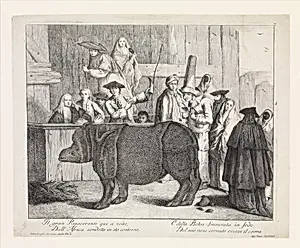
The Rhinoceros, Clara, in the foreground, her keeper holding her horn and a whip behind her at center with various other spectators in Carnival masks
Medium
Etching
Dimensions
Sheet: 16 5/16 × 20 1/4 in. (41.4 × 51.5 cm)
Classification
Prints
Department
Drawings and Prints
Museum
Metropolitan Museum of Art, New York, NY
Credit
The Elisha Whittelsey Collection, The Elisha Whittelsey Fund, 1979
Accession Number
1979.525.4
Rights
Public Domain
Tags
Art Historical Context
Step into the vibrant chaos of 18th-century Venice with this lively etching, *The Rhinoceros, Clara, in the foreground, her keeper holding her horn and a whip behind her at center with various other spectators in Carnival masks*. Created after ca. 1751 by Pietro Longhi (also known as Pietro Falca), with contributions from Alessandro Longhi and engraver Joseph Wagner, it captures a rare moment of exotic spectacle. Longhi, a master of Venetian genre scenes, delighted in portraying the city's everyday eccentrics and social whirl, here blending the extraordinary arrival of Clara—the famous touring rhinoceros—with the masked revelry of Carnival. Clara, shipped from India in 1741, became Europe's celebrity beast, drawing crowds across the continent before reaching Venice around 1751. This print places her prominently in the foreground, her keeper assertively guiding her amid gawking spectators, many women among them, disguised in fantastical Carnival masks. The etching medium, with its fine lines etched into a metal plate and inked for reproduction, allowed such sensational scenes to circulate widely, turning a live oddity into affordable art for the curious public. Measuring 16 5/16 × 20 1/4 inches, this work from the Metropolitan Museum of Art's Elisha Whittelsey Collection highlights the era's fascination with the "exotic" animal kingdom and Venice's blend of high society and street theater. It's a window into how 18th-century audiences marveled at the unfamiliar, their masked anonymity amplifying the thrill.