
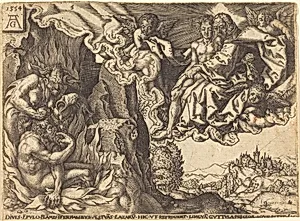
The Rich Man in Hell
after 1554
Medium
engraving
Classification
Department
CG-E
Museum
National Gallery of Art, Washington, D.C.
Credit
Rosenwald Collection
Accession Number
1943.3.234
Rights
Public Domain
Art Historical Context
**The Rich Man in Hell is a striking engraving created after the design of Heinrich Aldegrever, a German printmaker of the Renaissance known as one of the "Little Masters for his intricate small-scale works. Dated after 1554 and housed in the National Gallery of's Rosenwald Collection, piece exemplifies the technical precision of 16th-century engraving, a burin carves fine lines into a copper plate to produce detailed, reproducible images. Aldegrever's, influenced by Albrecht Dürer and the Nuremberg tradition, blends sharp realism with moral symbolism, making engravings like this ideal for widespread dissemination of religious narratives. The title draws from the New Testament parable of the Rich Man and Lazarus (Luke 16:19–31), a vivid cautionary tale popular in Protestant Reformation-era art. It depicts the torment of a wealthy man in hell for ignoring the poor, contrasting eternal punishment with heavenly reward—a theme that resonated amid 16th-century social upheavals and calls for charity. As a print, it allowed ordinary viewers to own and contemplate such sermons in visual form, underscoring engraving's role in democratizing art and piety. This work invites reflection on wealth, morality, and the afterlife, its enduring lines capturing Aldegrever's legacy in vivid, cautionary detail. (198 words)