
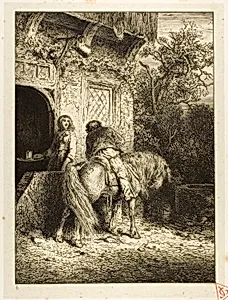
The Rider
Medium
Etching on cream China paper laid down on ivory wove paper
Dimensions
Image: 12.5 × 9.2 cm (4 15/16 × 3 5/8 in.); Chine: 13.7 × 10.2 cm (5 7/16 × 4 1/16 in.); Plate: 16.7 × 12.2 cm (6 5/8 × 4 13/16 in.); Sheet: 43.4 × 30.5 cm (17 1/8 × 12 1/16 in.)
Classification
etching
Department
Prints and Drawings
Museum
Art Institute of Chicago
Accession Number
45638
Rights
Public Domain
Art Historical Context
Charles Émile Jacque *The Rider* (1845) captures the quiet drama of rural life through the intimate medium of etching. A prominent French artist associated with the Barbizon school, Jacque specialized in pastoral scenes featuring peasants, animals, and landscapes drawing inspiration from the French countryside near Fontainebleau. This print, housed in the Art Institute of Chicago's Prints and Drawings, depicts a solitary rider, evoking the era's fascination with everyday equestrian figures amid natural settings. Printed on delicate cream China paper laid down on ivory wove paper, the work showcases etching's precision—acid biting into a metal plate to create fine, expressive lines. The modest image size (12.5 × 9.2 cm) belies its technical virtuosity, with layered tones achieving depth and texture typical of mid-19th-century French printmaking. China paper, prized for its absorbency, yields rich, velvety impressions that enhance the artwork's atmospheric quality. As a product of the 1840s Romantic-Realist shift, *The Rider* reflects broader cultural interests in authenticity and nature, making fine art accessible beyond paintings. Jacque's mastery of animal forms and rural narratives influenced later Realists, inviting visitors to appreciate the humble poetry of 19th-century French life.