
The Rider in the Woods, large plate
c. 1854
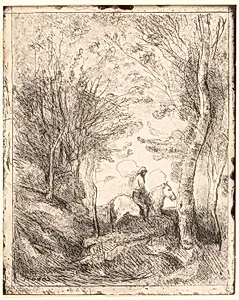
Medium
Cliché-verre on ivory photographic paper
Dimensions
Image: 28.5 × 22.6 cm (11 1/4 × 8 15/16 in.); Sheet: 30.2 × 24.2 cm (11 15/16 × 9 9/16 in.)
Classification
cliché-verre
Department
Prints and Drawings
Museum
Art Institute of Chicago
Accession Number
92312
Rights
Public Domain
Art Historical Context
Step into the shadowy allure of *The Rider in the Woods large plate* (c. 1854), a captivating work by Jean-Baptiste-Camille Corot, master of French landscape painting and a key figure in the Barb school. This intimate image, measuring about 11¼ × 8⅞ inches, depicts a solitary rider amid dense woodland, evoking the quiet mystery of nature that defined Corot's poetic vision. Housed in the Art Institute of Chicago's Prints and Drawings department, it exemplifies his innovative foray into experimental media during the mid-19th century. The artwork's medium—cliché-verre on ivory photographic paper—is a rare hybrid technique bridging drawing and early photography. Corot painted directly onto a glass plate with light-sensitive chemicals and opaque pigments, then contact-printed it to create unique, painterly photographs. Revived in the 1850s by artists like Corot alongside Delacroix and Daubigny, cliché-verre allowed for monotype-like effects with photographic precision, blending the artist's hand with light's alchemy. This "large plate" edition highlights Corot's curiosity at the dawn of modernism, predating widespread photography's influence. It underscores how 19th-century painters embraced new technologies, expanding printmaking's boundaries and foreshadowing impressionism's light play. A gem for visitors, it invites reflection on art's evolving edges.