
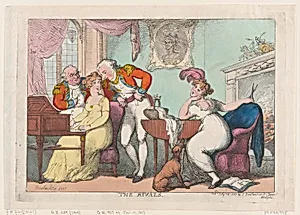
The Rivals
July 14, 1807
Medium
Hand-colored etching
Dimensions
Sheet: 10 1/2 × 14 15/16 in. (26.7 × 38 cm) Plate: 9 3/4 × 13 7/8 in. (24.7 × 35.2 cm)
Classification
Prints
Department
Drawings and Prints
Museum
Metropolitan Museum of Art, New York, NY
Credit
The Elisha Whittelsey Collection, The Elisha Whittelsey Fund, 1959
Accession Number
59.533.995
Rights
Public Domain
Tags
Art Historical Context
Thomas Rowlandson’s *The Rivals* (1807) is a delightful hand-colored etching that captures the witty spirit of early 19th-century British satire. Created during the Regency era, when social manners and romantic pursuits were ripe for mockery, this print exemplifies Rowlandson’s mastery of caricature. As a leading figure in London’s vibrant printmaking scene, Rowlandson produced thousands of such works, often poking fun at the upper classes foibles through exaggerated figures and lively scenes. The hand-coloring technique—applied by hand after etching the image onto a copper plate—brings vibrant energy to the composition, enhancing its humorous appeal. Common in Georgian-era prints, this method allowed for affordable yet vivid distribution via shops and publications. Tags hint at a domestic rivalry involving men, women, pianos, and dogs, likely depicting amorous competition in a genteel parlor, where music and pets add to the comedic tension. Housed in the Metropolitan Museum of Art’s Drawings and Prints department, this piece from The Elisha Whittelsey Collection highlights Rowlandson’s enduring cultural impact. His satirical etchings offer a window into Regency society’s obsessions with courtship and status, reminding us how art can both entertain and critique. (198 words)
About the Artist
Thomas Rowlandson · 1756–1827
Thomas Rowlandson (1757–1827) was an English artist and caricaturist whose satirical watercolors and prints captured the social life of Georgian Britain with unparalleled wit and technical mastery. Alongside James Gillray, he is recognized as one of the greatest British graphic artists, and his distinctive flowing line and keen observations have made his work integral to understanding late 18th an...