
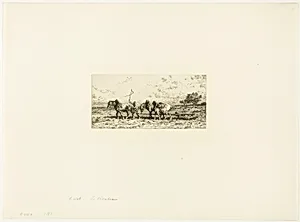
The Roller
Medium
Etching and plate tone on ivory laid paper
Dimensions
Image: 8.3 × 17.6 cm (3 5/16 × 6 15/16 in.); Sheet: 33.4 × 45.3 cm (13 3/16 × 17 7/8 in.)
Classification
etching
Department
Prints and Drawings
Museum
Art Institute of Chicago
Accession Number
133658
Rights
Public Domain
Art Historical Context
**The Roller** (1868) by Charles Émile Jacque captures a moment of rural labor through the meticulous medium of etching and plate tone on ivory laid paper. Jacque, a prominent French printmaker and painter of the Barbizon school (c. 1830–1870), was renowned for his realistic depictions of peasant life, farm animals, and pastoral landscapes. This intimate work, with its image measuring just 8.3 × 17.6 cm, exemplifies his skill in rendering everyday scenes with a keen eye for texture and atmosphere, housed today in the Art Institute of Chicago's Prints and Drawings department. Etching allowed Jacque to incise fine lines into a metal plate, creating intricate details like the textures of earth, machinery, and foliage, while plate tone—achieved by selectively wiping ink from the plate—adds subtle gradations of shadow and depth, evoking the soft light of the countryside. The generous sheet size (33.4 × 45.3 cm) provided space for wide margins, a hallmark of 19th-century fine prints prized by collectors. Created amid France's industrial expansion under Napoleon III, *The Roller* likely nods to emerging machinery flattening rural paths, blending tradition with modernity in Jacque's earthy palette. A charming window into 19th-century French life, it invites visitors to appreciate the artistry of printmaking's precision and poetry. (198 words)