
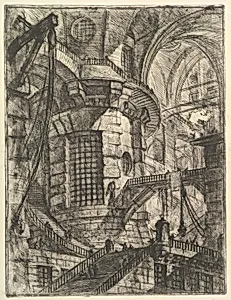
The Round Tower, from "Carceri d'invenzione" (Imaginary Prisons)
Giovanni Battista Piranesi|Giovanni Bouchard, ca. 1749–50
About this artwork
Giovanni Battista Piranesi's * Round Tower*, from the series *Carceri'invenzione* (inary Prisons), captures artist's visionary imagination around 1749–50. This etching depicts a fantastical architectural labyrinth of towering structures, endless stairs, and shadowy vaults, evoking a sense of boundless space and confinement. Piranesi, a masterful Italian printmaker active in Rome, drew inspiration from classical antiquity while pushing into surreal, proto-Romantic realms, blending real and invented elements to explore themes of human ambition and imprisonment. Executed as the first state of four (per Robison), the print employs intricate techniques including etching, engraving, sulphur tint or open bite, and burnishing on a grand scale—sheet dimensions of 24 13/16 x 19 1/2 inches. These methods allowed Piranesi to achieve dramatic contrasts of light and shadow, intricate details, and a sense of infinite depth, showcasing printmaking's technical prowess. As part of the Drawings and Prints collection at the Metropolitan Museum of Art (Harris Brisbane Dick Fund, 1937), it highlights how such processes democratized art, producing multiples that spread innovative visions widely. Piranesi's *Carceri* series influenced generations, from architects to surrealists, embodying the Enlightenment-era fascination with the sublime and the irrational. This work invites visitors to ponder the psychological tension between freedom and entrapment in its spiraling stairs and cavernous forms.