
The Royal Exchange
1844
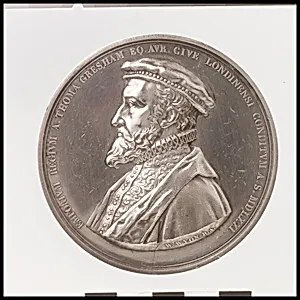
Medium
Silver
Dimensions
Diameter: 2 13/16 in. (71 mm)
Classification
Medals and Plaquettes
Culture
British
Department
European Sculpture and Decorative Arts
Museum
Metropolitan Museum of Art, New York, NY
Credit
Gift of Assunta Sommella Peluso, Ada Peluso, and Romano I. Peluso, in memory of Ignazio Peluso, 2000
Accession Number
2000.323.5
Rights
Public Domain
Tags
Art Historical Context
Behold *The Royal Exchange*, a stunning silver medal crafted in 1844 by Williamon, the esteemed chief engraver of the Royal Mint. Measuring just 2 13/16 inches in diameter, this finely detailed plaquette captures the grandeur of London's iconic commercial hub through intricate engravings of architectural facades, regal profiles of men and women—likely evoking Queen Victoria and Prince—and symbolic elements of prosperity. Wyon's mastery of the medal form, rooted in neoclassical precision, this small-scale work into a miniature masterpiece of British decorative arts. Struck to commemorate the opening of the third Royal Exchange on October 28, 1844, by Queen Victoria, the medal celebrates a pivotal moment in London's mercantile history. The original Exchange, founded by Sir Thomas Gresham in 1568, had twice burned down; this neoclassical rebuild by Sir William Tite symbolized Victorian Britain's economic might and imperial ambition. As a tangible record of national pride, it reflects the era's fascination with numismatic art to immortalize public events. Wyon's technique—high-relief engraving on silver—highlights his skill in conveying depth and texture, making the building's columns and figures leap from the surface. Housed in The Metropolitan Museum of Art, this gift honors Ignazio Peluso and invites us to appreciate how medals bridged fine art and everyday commemoration in 19th-century Britain.
About the Artist
William Wyon · 1795–1851
British, Birmingham 1795–1851 Brighton