
The Rubens Hat
1875
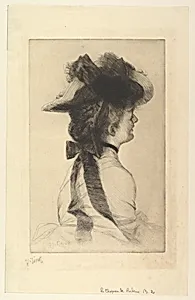
Medium
Etching on laid paper; second state of two
Dimensions
Plate: 10 7/16 x 6 3/4 in. (26.5 x 17.2 cm) Sheet: 13 7/8 x 9 in. (35.3 x 22.8 cm)
Classification
Prints
Department
Drawings and Prints
Museum
Metropolitan Museum of Art, New York, NY
Credit
Harris Brisbane Dick Fund, 1924
Accession Number
24.73.4
Rights
Public Domain
Tags
Art Historical Context
**The Rubens Hat**, created by James Tissot 1875, is a delicate etching on laid paper, capturing the elegance of Victorian fashion in its second state of two.issot, a French artist who thrived in London's cosmopolitan scene after the Franco-Prussian War, was for his meticulous depictions of high society women. This print, measuring 10 7/16 x 6 3/4 inches on the plate, showcases his transition from painting to printmaking, allowing wider dissemination of his stylish vignettes. The work features a woman's profile, adorned with an elaborate hat evoking the opulent Baroque style of Peter Paul Rubens—hence the title. Etching's fine lines and tonal depth highlight the hat's feathers, lace, and curves, emphasizing texture and silhouette against a simple background. Produced during the 1870s "crinoline era," it reflects the era's obsession with extravagant millinery as symbols of femininity and status. Acquired through the Harris Brisbane Dick Fund in 1924, this piece from the Metropolitan Museum of Art's Drawings and Prints collection exemplifies Tissot's blend of Realism and fashion illustration. It invites viewers to appreciate how prints democratized art, preserving fleeting trends for posterity. (198 words)
About the Artist
James Tissot · 1836–1902
James Tissot (1836–1902) was a French painter and printmaker who spent much of his career in England and became renowned for his meticulously detailed depictions of fashionable Victorian society. Born Jacques Joseph Tissot in Nantes, he studied at the École des Beaux-Arts in Paris under Louis Lamothe and Hippolyte Flandrin and exhibited at the Salon from 1859. Tissot's early career in Paris produ...