
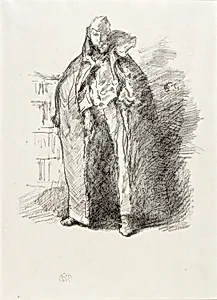
The Russian Schube
Medium
Graphic Arts-Print
Classification
Graphic Arts-Print
Department
Smithsonian Collection
Museum
Smithsonian American Art Museum
Credit
Smithsonian American Art Museum, Museum purchase
Accession Number
1971.112
Rights
Public Domain
Tags
Art Historical Context
James McNeill Whistler’s *The Russian Schube*1896) is a striking lithograph from his later career, capturing a full-length figure draped in a luxurious Russian fur coat, or *shuba*. As an American-born artist who made his mark in Britain, Whistler a leading figure in the Aesthetic movement emphasizing "art for art’s sake" through harmonious tones and subtle compositions rather than narrative detail. This print exemplifies his of graphic arts, using soft lithography to evoke texture and form with delicate lines and tonal gradations. Created during a period when Whistler experimented boldly with printmaking—producing over 500 etchings and lithographs—this work reflects his fascination with exotic attire and elegant silhouettes. The *shuba*, a traditional Russian garment symbolizing opulence and warmth against harsh winters, adds a layer of cultural intrigue, possibly inspired by Whistler’s travels or cosmopolitan circle. Acquired through museum purchase for the Smithsonian American Art Museum, it highlights his influence on modern graphic techniques, bridging 19th-century realism with impressionistic subtlety. Visitors will appreciate how Whistler’s economical style invites contemplation of light, shadow, and fabric’s flow, making *The Russian Schube* a timeless gem in the museum’s collection.
About the Artist
James McNeill Whistler · 1834–1903
James Abbott McNeill Whistler (1834-1903) was an American-born painter and printmaker who became a leading figure in the Aesthetic Movement and pioneer of Tonalism and Japonisme. He revolutionized art by championing "art for art's sake" and treating paintings as visual equivalents of musical compositions, titling works as "arrangements," "harmonies," and "nocturnes" to emphasize formal qualities o...