
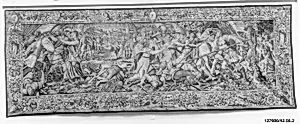
The Sabine Women Stopping the Battle between the Romans and the Sabines from the Story of the Romans and the Sabines
Medium
Wool, silk (19-21 warps per inch, 7-9 per cm.)
Dimensions
H. 85 x W. 234 inches (215.9 x 594.4 cm)
Classification
Textiles-Tapestries
Culture
Flemish, Brussels or Antwerp
Department
European Sculpture and Decorative Arts
Museum
Metropolitan Museum of Art, New York, NY
Credit
Rogers Fund, 1942
Accession Number
42.56.2
Rights
Public Domain
Tags
Art Historical Context
This magnificent tapestry, *The Sabine Women Stopping the Battle between Romans and the Sabines*, is a collaborative masterpiece from the Flemish workshops of Brussels or Antwerp, woven between 1570 and 1585. Designed by Nicolas van Orley with contributions from Joost vanzeele and Gerard deode, it captures a pivotal moment from Roman legend: the Sabine women rushing between warring Romans and Sabines to halt the bloodshed, pleading for peace and family unity. Part of a larger series on the *Story of the Romans and the Sabines*, it reflects the Renaissance fascination with classical antiquity, brought to life in vibrant wool and silk threads. Measuring an imposing 85 by 234 inches, this textile exemplifies the technical virtuosity of 16th-century Flemish tapestry production, with a fine weave of 19-21 warps per inch. Such opulent wall hangings adorned the palaces of Europe's elite, serving as both insulation and status symbols while narrating heroic tales. The intricate interplay of battling men and intervening women highlights themes of conflict, valor, and reconciliation, rendered with dramatic energy that rivals contemporary paintings. Acquired through the Rogers Fund in 1942, this piece from the Metropolitan Museum of Art's European Sculpture and Decorative Arts collection invites visitors to ponder the enduring power of myth in art—where threads weave history into a tapestry of human drama.
About the Artist
Nicolas van Orley|Joost van Herzeele|Gerard de Jode ( |Flemish|Netherlandish) · 1540 |1520 |1509 –1615 |1589 |1591
active 1570–1585|Flemish, active before 1580–89|Netherlandish, 1509/17–1591