
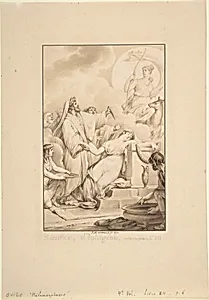
The Sacrifice of Iphigenia
Medium
Brush and brown ink with brown wash
Dimensions
8 3/4 x 6 1/8 in. (22.2 x 15.6 cm)
Classification
Drawings
Department
Drawings and Prints
Museum
Metropolitan Museum of Art, New York, NY
Credit
Gift of Alexander B.V. Johnson and Roberta J.M. Olson, 1994
Accession Number
1994.535.2
Rights
Public Domain
Tags
Art Historical Context
In the poignant drawing *The Sacrifice of Iphia* (1810), French artist Jean Michel Moreau the Younger captures a dramatic moment from Greek mythology. The scene depicts tragic tale of Iphigenia, daughter of Agamemnon offered as a sacrifice to the goddess Artemis to appease the and summon winds for the Trojan War. Moreau's composition highlights the emotional intensity, with tags noting female nudes, men, animals—likely evoking the deer that famously substitutes for Iphigenia in versions—and central figures like the bound young woman amid priests and warriors. Created during the Neoclassical era, Moreau, a master illustrator known for his refined line work and engravings inspired by classical antiquity, employs brush and brown ink with brown wash. This monochromatic technique, akin to grisaille, allows subtle tonal modeling and dramatic chiaroscuro on the small sheet (8 3/4 x 6 1/8 in.), evoking the solemnity of ancient vase paintings while showcasing 19th-century precision. Popular in salons and livres d'heures, such drawings bridged fine art and reproductive printmaking. Today, this gift to the Metropolitan Museum of Art's Drawings and Prints department exemplifies Moreau's legacy in revitalizing mythic narratives, inviting visitors to ponder themes of duty, fate, and divine intervention that resonated in post-Revolutionary France.