
The Sacrifice of Marcus Curtius
1640s
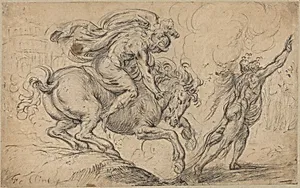
Medium
black chalk on laid paper
Dimensions
Overall: 18.1 x 28.9 cm (7 1/8 x 11 3/8 in.) support: 26 x 37.3 cm (10 1/4 x 14 11/16 in.)
Classification
Drawing
Department
CG-E
Museum
National Gallery of Art, Washington, D.C.
Credit
Ailsa Mellon Bruce Fund
Accession Number
1984.45.1
Rights
Public Domain
Art Historical Context
Franz Cleyn’s drawing, *The Sacrifice of Marcus Curtius*, offers a compelling glimpse into 17th-century draftsmanship. Created in the 1640s with black chalk on laid paper, the work measures just over 7 by 11 inches, making it an intimate study that close viewing. The medium allows for delicate lines and rich tonal modeling, enabling Cleyn to suggest movement and depth on a modest scale while the larger support sheet provides a protective border typical of old-master drawings. As a preparatory work, this piece reflects the central role drawings played in an artist’s process during the Baroque era, serving as explorations for paintings, tapestries, or prints. Cleyn, who worked across northern Europe and England, brought a fluid, expressive touch to classical subjects, bridging Renaissance ideals with emerging dramatic sensibilities of his time. Now part of the National Gallery of Art’s collection thanks to the Ailsa Mellon Bruce Fund, the drawing invites visitors to appreciate both the technical mastery of black-chalk technique and the enduring fascination with heroic Roman legends in European art.