
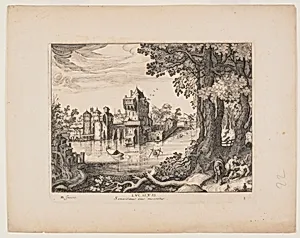
The Samaritan Finding the Man, from Landscapes with the Story of the Good Samaritan
c. 1600-1620
Medium
Etching on ivory laid paper
Dimensions
Plate: 17.8 × 23 cm (7 1/16 × 9 1/16 in.); sheet: 25.3 × 32.2 cm (10 × 12 11/16 in.)
Classification
etching
Department
Prints and Drawings
Museum
Art Institute of Chicago
Accession Number
267926
Rights
Public Domain
Art Historical Context
In the early 17th century, engraver Simon Frisius crafted *The Samaritan Finding the Man a poignant etching from his series *Landscapes with the Story of Good Samaritan*. This scene captures a key moment from the New Testament parable in Luke , where a compassionate Samaritan discovers a traveler beaten and abandoned by robbers along a roadside. Frisius's composition blends dramatic narrative with expansive landscapes, reflecting the Northern European tradition of embedding moral lessons within naturalistic settings—a hallmark of the emerging Dutch Golden Age. Etched on delicate ivory laid paper, the print measures a modest plate size of 17.8 × 23 cm, allowing for intricate details in foliage, figures, and distant vistas. Etching, a technique Frisius mastered, involved biting acid into a metal plate to create fluid, expressive lines, offering greater freedom than traditional engraving. This medium democratized art, enabling wider distribution of biblical stories during a time of religious fervor post-Reformation. Housed in the Art Institute of Chicago's Prints and Drawings Department, this work exemplifies Frisius's skill in reproductive printmaking, inviting viewers to ponder themes of mercy and humanity amid serene yet evocative scenery. A timeless reminder of compassion, it bridges art and spirituality for modern audiences.