
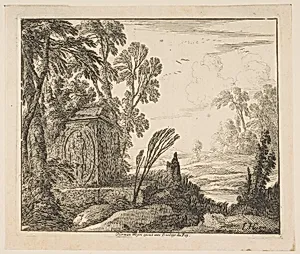
The Sarcophagus
Medium
Etching; first state of two (Robert-Dumesnil)
Dimensions
sheet: 4 15/16 x 5 7/8 in. (12.6 x 15 cm) plate: 4 1/2 x 5 7/16 in. (11.5 x 13.8 cm)
Classification
Prints
Department
Drawings and Prints
Museum
Metropolitan Museum of Art, New York, NY
Credit
Harris Brisbane Dick Fund, 1928
Accession Number
28.91.6
Rights
Public Domain
Tags
Art Historical Context
Created in 1640, *The Sarcophagus* is a delicate etching by Laurent de La Hyre, with Herman Weyen likely responsible for the printmaking process. Measuring just under five by six inches, this small-scale work captures the quiet grandeur of an ancient stone coffin, reflecting the 17th-century fascination with classical antiquity. As a first-state impression, it offers a rare glimpse into the early stages of the print’s development. La Hyre, a leading figure in the French classical tradition, often drew inspiration from Roman and Greek motifs during the reign of Louis XIII. Etching allowed artists like him to reproduce intricate details—such as carved reliefs and architectural ornament—with remarkable precision and subtlety. This print would have circulated among collectors and scholars, helping spread knowledge of ancient funerary art across Europe. Housed today in the Metropolitan Museum of Art’s Department of Drawings and Prints, the work exemplifies how 17th-century French artists bridged the worlds of painting and printmaking. Its modest size belies its cultural importance as both an artistic object and a vehicle for preserving classical heritage.
About the Artist
Herman Weyen|Laurent de La Hyre (Flemish|French) · 1600 |1602 –1672 |1676
Flemish, died Paris, 1672|French, Tours 1602/04–1676 Paris