
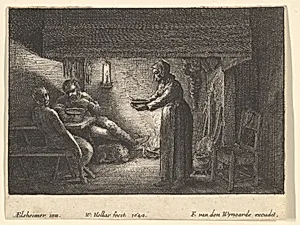
The satyr and the peasant
Medium
Etching, first state of two
Dimensions
Sheet: 2 13/16 × 3 3/4 in. (7.2 × 9.5 cm) cut outside borderlines but within platemark
Classification
Prints
Department
Drawings and Prints
Museum
Metropolitan Museum of Art, New York, NY
Credit
Purchase, Joseph Pulitzer Bequest, 1917
Accession Number
17.50.18-245
Rights
Public Domain
Tags
Art Historical Context
Behold *The Satyr and the Peasant*, a delicate etching from 1644, now housed in the Metropolitan Museum of Art's Department of Drawings and Prints.ributed to Adam Elsheimer alongside etchers Wenceslaus Hollar and van den Wyngaerde this first-state impression captures a whimsical mythological encounter in an intimate scale—measuring just 2 /16 × 3 3/4 inches. Acquired through the Joseph Pulitzer Bequest 1917, it 17th-century reproductive printmaking, where skilled engravers translated paintings into accessible prints for collectors. The scene evokes classical fables, featuring a satyr—a half-human, half-goat woodland spirit—interacting with a rustic peasant, highlighting tensions between the wild, mythical world and everyday human life. Elsheimer, known for his luminous small-scale works, likely inspired the original composition, while Hollar and van den Wyngaerde's etching technique shines in its precise lines and tonal depth, even within the platemark. As a "first state of two," this rare early version preserves the artists' initial vision before later revisions. This tiny print offers a window into Baroque-era fascination with antiquity and nature, blending humor and moral allegory in a format perfect for scholarly contemplation. A true collector's delight!
About the Artist
Adam Elsheimer|Wenceslaus Hollar|Frans van den Wyngaerde · 1578–1610
Elsheimer's meticulously detailed small paintings on copper would establish him as the most influential artist to follow Albrecht Dürer. He most likely arrived in Italy ca. 1598, where he quite possibly was associated with Hans Rottenhammer, and then moved to Rome in 1600, where he remained until his death. Comment on works: Landscapes; Religious.