
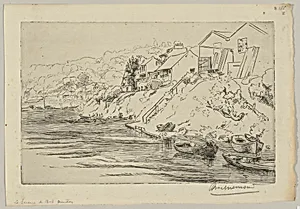
The Sawmill of Bas-Meudon
Medium
etching on laid paper
Dimensions
plate: 40.13 × 63.25 cm (15 13/16 × 24 7/8 in.) sheet: 50.29 × 71.63 cm (19 13/16 × 28 3/16 in.)
Classification
Department
CG-E
Museum
National Gallery of Art, Washington, D.C.
Credit
The Helena E.M. Gunnarsson Fund
Accession Number
2023.65.3
Rights
Public Domain
Art Historical Context
Félix Bracquemond *The Sawmill of Basudon* (1868) is a masterful etching that captures the gritty rhythm of industrial life along the Seine River suburbs of Paris. As a leading figure in France's 19th-century revival, Bracquem elevated printmaking to fine art, blending precise linework with atmospheric depth. This large-scale plate (40.13 × 63.25 cm) on laid paper—characterized by its subtle chain lines from traditional papermaking—showcases his technical prowess, allowing for intricate details in the sawmill's machinery, stacked logs, and workers amid a lush, wooded backdrop. Created during the Second Empire's rapid modernization, the work reflects the tension between nature and industry, a theme resonant in emerging Realist and Impressionist circles. Bracquemond, influenced by Japanese prints, employed aquatint and drypoint techniques to evoke texture and light, making this not just a document of daily labor but a study in light filtering through trees and steam. Housed in the National Gallery of Art's Prints department through the Helena E.M. Gunnarsson Fund (CG-E), this etching invites visitors to appreciate how Bracquemond bridged meticulous craftsmanship with the era's social shifts, offering a window into a transforming France.
About the Artist
Félix Bracquemond · 1833–1914
French, Paris 1833–1914 Sèvres