
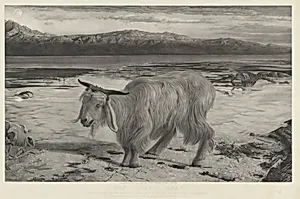
The Scapegoat
Medium
etching, engraving, and mezzotint on wove paper
Dimensions
plate: 61.9 x 92.2 cm (24 3/8 x 36 5/16 in.) sheet: 70.1 x 98.3 cm (27 5/8 x 38 11/16 in.)
Classification
Department
CG-E
Museum
National Gallery of Art, Washington, D.C.
Credit
Paul Mellon Fund
Accession Number
2001.118.33
Rights
Public Domain
Art Historical Context
This 1861 print, created by Charles Mottram after William Holman Hunt’s celebrated painting, captures one of the most striking images of the Pre-Raphaelite movement. Hunt, a founding member of the Brotherhood, traveled to the Holy Land to paint the subject on site, depicting a solitary white goat abandoned in the barren landscape beside the Dead Sea. The image draws on the ancient Jewish ritual described in Leviticus, in which a goat symbolically carried the community’s sins into the wilderness, offering viewers a powerful meditation on sacrifice and redemption. Reproductive prints such as this one played an essential role in the nineteenth century by making major paintings accessible beyond the walls of private collections or exhibitions. Mottram employed a sophisticated combination of etching, engraving, and mezzotint to translate Hunt’s luminous colors and meticulous detail into rich tonal gradations on paper. The large scale of the plate—nearly a meter wide—further underscores the ambition to preserve the painting’s dramatic impact for a broader audience. Today the work stands as both an artistic achievement in its own right and a testament to the Victorian fascination with biblical narrative and precise natural observation.