
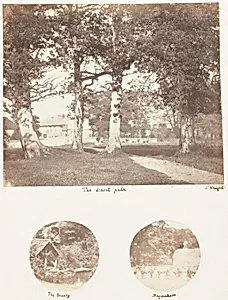
The School Path; The Shanty; Haymakers
1853–56
Medium
Salted paper print
Dimensions
Image: 14.1 × 17.2 cm (5 9/16 × 6 3/4 in.) (a) Image: 5.5 × 5.5 cm (2 3/16 × 2 3/16 in.) (b), circular Image: 5.5 × 5.5 cm (2 3/16 × 2 3/16 in.) (c), circular
Classification
Photographs
Department
Photographs
Museum
Metropolitan Museum of Art, New York, NY
Credit
Gilman Collection, Gift of The Howard Gilman Foundation, 2005
Accession Number
2005.100.382 (29a–c)
Rights
Public Domain
Tags
Art Historical Context
James Knight's *The School Path; The Shanty; Haymakers* (1853–56) offers a charming glimpse into mid-19th-century rural life through three salted paper prints. The larger rectangular image captures a winding *School Path* lined with modest buildings, evoking the quiet paths children might have trod to school. Accompanying it are two intimate circular vignettes: *The Shanty*, depicting a humble hut amid landscapes, and *Haymakers*, portraying laborers and horses at work in the fields. These diminutive prints—ranging from 5.5 cm squares to 14.1 × 17.2 cm—highlight the intimate scale of early photography. Salted paper prints, a pioneering wet-collodion era technique, involved coating paper with salt and silver nitrate for a soft, luminous tonal range that mimicked painting. Knight, active in 1850s Britain, used this method to document everyday scenes with a poetic realism, predating more precise processes like albumen. Collected in the Met's Gilman Collection, these works underscore photography's rapid evolution from novelty to art, preserving fleeting moments of agrarian harmony. (198 words)
About the Artist
James Knight
James Knight was a British artist active during the mid-nineteenth century, best known for his work as a photographer producing salted paper prints. His identity remains somewhat elusive in historical records, though he is documented as working in Britain during the 1850s and 1860s. No details of his early life, formal training, or artistic mentors have been identified in available sources. Knigh...